
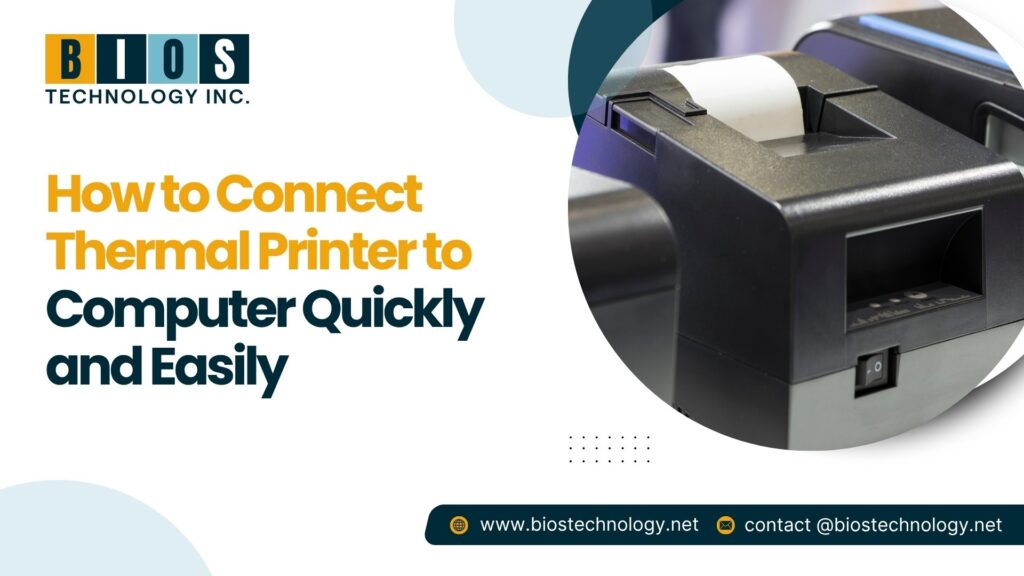
No matter if you’re managing an online store, running an office at home, or setting up an automated point-of-sale system, understanding the best way to link a printer to the computer is a crucial technique that can save you time and ease the stress of having to wait for receipts or labels. The best part? It’s easier than people think. This guide takes you through each method, including thermal printer for Chromebook configurations that a lot of guides miss.
What Is a Thermal Printer and Why Does It Matter?
The thermal printer makes use of the heat of the sun to create prints on special coated paper without cartridges of ink or toners, so there’s no mess. They are commonly used to print receipts, shipping labels, tickets, and barcodes. They’re fast, efficient, reliable, and economical over the long term.
The most popular brands are Zebra, Epson, Star Micronics, Rollo, and MUNBYN. Each connects to different computers; the basic process is the same.
Method 1: Connect via USB (Most Common)
USB is the most secure and fastest method of connecting a thermal printer to a Windows or Mac computer.
Step-by-Step:
- Connect the USB cable of your printer to an accessible USB port on your computer.
- Turn on the printer by pressing the power button.
- Be patient and wait for automatic detection. Then, Windows 10/11 will often install drivers automatically in a matter of seconds.
- Check the connection by navigating through Settings – Devices – Printers & Scanners and verifying that the printer is visible.
- Print a test print by clicking on the printer’s right side and choosing “Printer Properties.”
If the drivers aren’t installed automatically, go to the official site of the manufacturer and download the proper driver for your system.
Method 2: Connect via Bluetooth
Bluetooth thermal printers work great for portable setups, small workstations, or any other situation in which cable management is an issue.
Step-by-Step:
- Make sure you enable Bluetooth in your printer (usually through a button or switch).
- When you’re on your PC, click Settings – Bluetooth and Devices and then Add Device.
- Choose which printer you want to use from the devices.
- Connect the devices and await confirmation.
- Set the thermal printer to be your default printer, if you need to.
Pro Tip: Place your printer within 10 metres of your computer to ensure a reliable Bluetooth connection.
Method 3: Connect via Wi-Fi / Network
A thermal printer that is network-connected is perfect for offices that have multiple computers and have to share a printer.
Step-by-Step:
- Connect your printer to the Wi-Fi network by using its built-in display/menu, or WPS button.
- Make note of your printer’s IP address on the settings screen.
- If you are using a computer, click Control Panel > Devices and Printers. Add Printer.
- Choose “Add a printer locally” and then select the new port to be the standard TCP/IP port.
- Input the IP address, and follow the prompts on screen to complete the installation.
Chromebook Printer Setup: A Complete Guide
The process of setting up the thermal printer on Chromebook is a subject that is a source of confusion for many because ChromeOS is different than Windows as well as macOS. Here’s what you should be aware of.
Option A: Use Google Cloud Print Alternative (CUPS)
Google discontinued Cloud Print in 2021. Presently, Chromebooks use CUPS (Common Unix Printing System) natively.
- Go to Settings – Advanced – Print and Scan – Printers.
- Click “Add Printer.”
- When your printer’s connected to the same Wi-Fi network, ChromeOS could be able to detect the printer automatically.
- If you don’t, then select “Add Automatically” and type in the IP address of your printer along with its protocol (usually IPP or LPD).
- Choose a suitable PPD driver file if you are prompted.
Option B: USB Connection on Chromebook
- Connect the USB thermal printer to your Chromebook.
- ChromeOS should recognize it and ask you to enable it.
- Click on Settings > Printers, and confirm that the printer is there.
- Print a test page using Google Docs or Chrome browser.
Option C: Make use of the manufacturer’s apps available on the Play Store
Some printer manufacturers provide Android applications available through the Google Play Store. Google Play Store — and as Chromebooks are compatible with Android apps, it’s an easy alternative to Chromebook printer configuration.
- Download the app that is brand-specific to your company (e.g., Zebra Setup Utilities, MUNBYN Print, Star Micronics).
- Connect through Bluetooth or USB and then configure the printer through the application.
Troubleshooting Common Connection Issues
With the correct steps, there are times when things can be a mess. Here are quick fixes:
- Printer not recognized by USB? Try using a different connection and/or USB port. Restart both devices.
- Bluetooth keeps dropping? Update your firmware and make sure there is no interference from wireless devices.
- Do you have the wrong size of paper? Open the printer preferences and then set the correct receipt or label dimensions.
- ChromeOS reports “Printer is not supported.” Find a Linux (Beta) driver. You can also download an Android application available on the Play Store to work around the issue.
Conclusion
Connecting a printer with a thermal cable to an operating system, whether that’s a Windows PC, Mac, or Chromebook, does not have to be a difficult task. If you use the correct technique (USB, Bluetooth, or Wi-Fi) and have a thorough knowledge of the settings for your operating system’s printer, you can get printing in a matter of minutes.
For Chromebook printer configuration, the process has changed dramatically since the time in Google Cloud Print, and the current version of ChromeOS provides robust support built-in that a lot of users do not realize exists.
At Bios Technology, we go beyond setting up guides. We provide in-depth analyses of the most current thermal printer models, a comparison between different connectivity options, troubleshooting walkthroughs, and expert advice on selecting the right printer for personal or professional use. We’ve got all the answers.
Go to Bios Technology for more insights on the latest tutorials, as well as technological advice that will keep your technology up-to-date. Printers and peripherals included, we can help you get the most out of technology.
FAQs
Q1. Do I have the ability to connect my thermal printer to the Chromebook with no Wi-Fi?
Yes! It is possible to connect a thermal printer to the Chromebook by a direct USB connection or Bluetooth. ChromeOS supports both of these options. Just plug in the USB cable or pair it via Settings and then Bluetooth, and ChromeOS will recognize the printer and guide you through a short procedure to set up the printer.
Q2. Do thermal printers require special drivers to run on Windows 11?
The majority of modern thermal printers work with Windows 10 and 11, which means that drivers are installed automatically when you connect through USB. However, to have complete control of features, including changing the size of labels or print speed density, it’s suggested that you download the driver installation package from the manufacturer’s website.
Q3. What is the reason my printer is not printing pages that are blank?
It’s usually a paper-loading problem; it’s not a connectivity issue. The thermal paper has a coated surface that reacts with heat. When the sheet is loaded upside-down, nothing prints. Unroll the roll and flip it over, load it, and then run an experiment print.
Q4. Do multiple PCs share a thermal printer on an internet connection?
Absolutely. If your printer supports Wi-Fi or Ethernet, and you want to assign it a static IP address to connect it to multiple computers by using the TCP/IP port technique described previously. This is often used in warehouse and retail environments where multiple workstations share a single receipt printer or label.
Q5. What is the most efficient thermal printer suitable for Chromebook users?
Choose Printers which are Google Cloud Ready certified, have support for IPP (Internet Printing Protocol), or come with an official Android application available on the Play Store. Brands such as Zebra, Rollo, and MUNBYN are well-known choices that have been proven to be compatible with ChromeOS. Always confirm Chromebook compatibility with the product page of the manufacturer prior to buying.
