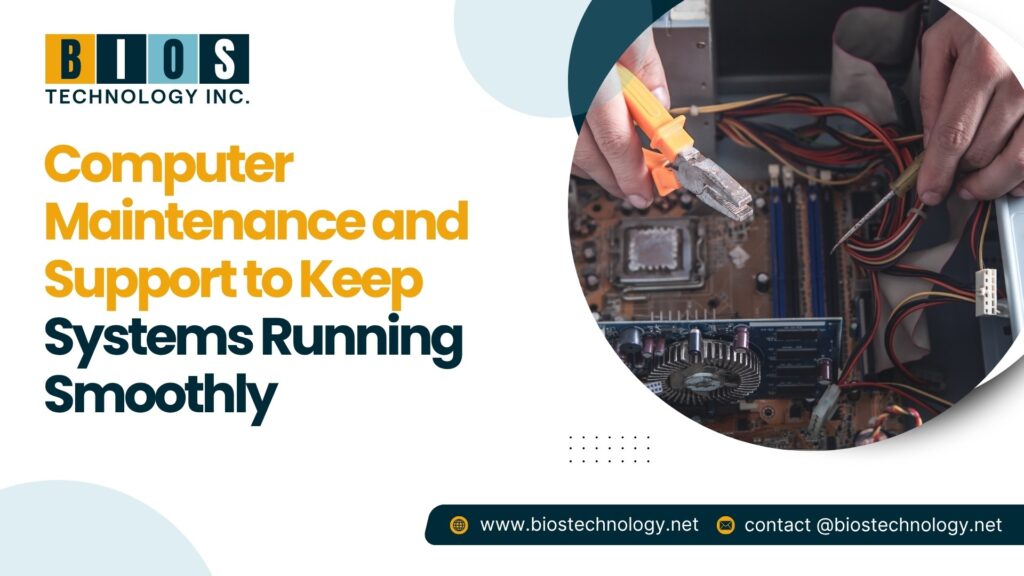
Computers are the mainstay of the modern-day business, including invoices, emails, as well as customer records and even daily routines. If a computer slows down or freezes, or is attacked by malware, it ceases to function. This is why maintenance of computers and IT support don’t have to be a burden anymore. They’re the essential tools needed to keep the business functioning.
This guide will explain what maintenance for computers actually means, why it is important and how to tell when your company needs assistance.
What Is Computer Maintenance and IT Support?
Maintenance of your computer is the continuous monitoring of your computer’s hardware and software to ensure that everything is functioning perfectly. It comprises:
- Installing security software and installing security updates
- Inspecting the equipment for damage and wear.
- Removal of malware and viruses
- Important files should be saved as backups
- Be on the lookout for network issues
- Solutions to problems employees face
The idea is simple: identify small issues before they become big, costly ones.
1 in 3 Small Businesses Lose Productivity to Tech Downtime
Unplanned downtime is among the most frequent — and expensive — issues companies face. One server crash or network issue can stop the work process for long periods of time. Research studies on small-business IT trends reveal that a significant portion of small businesses experience at the very least one major system failure each year, mostly due to routine maintenance not being done.
Regular checks identify broken hardware and software before they trigger shutdowns, which keeps teams on track instead of waiting for repairs.
5 Core Benefits of Regular Computer Maintenance
1. Faster, More Reliable Systems
Over time, computers accumulate garbage files, unneeded programs, and background processes that slow down everything. Regular cleaning helps keep computers operating at maximum speed, which means that apps run faster and employees spend less time waiting around.
2. Fewer Data Losses
Data is lost due to hardware malfunction as well as accidental deletion and cyberattacks more frequently than businesses expect. Backups scheduled for the future mean that the worst happens the data you have stored can be restored quickly, instead of disappearing forever.
3. Stronger Protection Against Cyberattacks
Cyberattacks targeting medium- and small-sized companies have increased dramatically in recent times, with phishing and ransomware among the top threats. IT team members patch security holes, use antivirus software, and monitor the for any suspicious activities — thereby closing the doors that hackers rely on.
4. Less Downtime, More Output
Each hour a system goes down, that’s an hour of unproductive work. Regular maintenance can identify alarm signs — like an inoperable hard drive or an overheated server — prior to them causing the system to shut down completely.
5. Longer Equipment Lifespan
Computers and servers are good investment. Regular cleaning, servicing, and optimization of software could prolong a device’s usable lifespan, which results in fewer expenses for replacement.
7 Warning Signs Your Business Needs IT Support Now
Many businesses put off a problem until it is completely broken before soliciting assistance. Look out for these signs instead:
- Computers take noticeably longer to load or start programs
- The frequent freezing or crashes
- Internet connections are slow or intermittent.
- Pop-ups, unusual alerts, or warnings about antivirus
- Software that hasn’t been upgraded over the past few months
- Backups that fail or aren’t working in the timeframes that are set
- Incessant, unexplained downtime
If more than two of these sound familiar, it’s a clear indication that your systems require professional care.
What a Good IT Maintenance Plan Covers
A well-constructed maintenance and support plan usually includes six key services:
| Service | What It Does |
| Software updates | Maintains operating systems and applications up-to-date and safe |
| Malware protection | Removes and blocks spyware, viruses and ransomware |
| Hardware checks | Failure spots on components prior to when they fail |
| Backup and recovery of data | Secures your files and helps restore them in the event of a problem |
| Network monitoring | Monitors connections and servers for any slowdowns or outages. |
| Help desk support | Solutions to day-to-day technical issues for employees |
Why Small Businesses Can’t Afford to Skip IT Support
Many small-scale business owners believe that IT services are only required for larger corporations that employ hundreds of people. However, smaller businesses are usually more vulnerable as they usually have fewer backup systems and less money to deal with an attack or a massive interruption.
Outsourced IT support offers small-sized businesses the same level of protection as larger corporations, but without the expense of hiring an internal team. Benefits include:
- Costs for IT that are predictable and budget-friendly
- More secure cybersecurity without an internal department
- There are fewer interruptions to the daily operation
- Access to specialists instead one generalist
- More time to concentrate on growing and enhancing the customer experience.
How to Choose the Right IT Support Partner
Many providers provide the same level of service. When you are comparing providers be sure to be sure to look for:
- Experiential knowledge across various sectors and systems
- Quick response times, particularly in the case of urgent problems.
- Monitoring proactively, not only reactively, fixes
- Plans that can be scaled to grow as your business expands
- Transparent, clear pricing without hidden costs
- Reliable client reviews as well as references
A reliable IT partner should be an integral part of the company, accessible, responsive, and focused on the prevention of issues rather than fixing problems after they’ve occurred.
The Bottom Line
Bios Technology is a constant force in business, but only when it’s maintained properly. Regular maintenance of your computer and dependable IT support will safeguard your data, cut downtime, improve security, and prolong the lifespan of your equipment, all while allowing your staff to concentrate on work that will grow your business.
If you’re a five-person start-up or a 50-person business, investing in continuous IT support is no longer an option. It’s among the most effective methods to safeguard your business from costly and non-viable interruptions.

